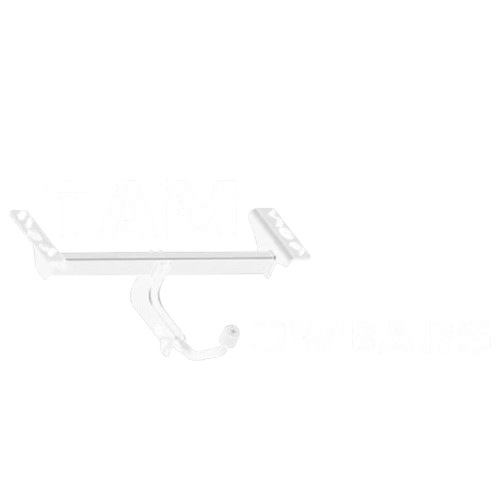

"Towbar" sounds like one product, but there are actually several different designs, each suited to different needs. Here's a rundown of the main types you'll come across.
1. Fixed towbar
The standard, no-frills option. It's a single, permanent unit bolted onto the vehicle — the tow ball is always there, whether you're towing or not. It's the simplest design, has no moving parts to maintain, and is generally the most affordable option. The trade-off is that the ball sticks out permanently, which some people don't love the look of on their daily driver.
2. BMA — diagonally detachable towbar
A detachable towbar lets you remove the tow ball entirely when you're not using it, leaving a much cleaner look at the back of the car. The BMA is the diagonally detachable version: you clip the ball in and out at a slight angle, and part of its mounting sleeve stays visible under the bumper. Its main strength is convenience — the ball goes on and comes off quickly and easily, and locks in place with a key for security when it's fitted. The removed ball and neck pack away into a bag that stores in the boot.
3. BMU — vertically detachable towbar
The BMU is the other detachable style, and the one we generally recommend. Instead of clipping in diagonally, the ball attaches vertically, and its mounting sleeve is fully hidden behind the bumper — so with the ball removed, there's no visible sign there's a towbar there at all. It gives the neatest, most factory-look finish of any detachable design, while still locking in securely with a key when you need to tow. The BMU is also the version that fits sport and performance trims (GTI, AMG, S/RS-line, SRT8, and similar) that other towbars are listed as not fitting — it just needs a slightly bigger bumper cut to do it.
4. Retractable towbar
A retractable towbar is a fixed swan-neck unit that's motorised — press a button and the ball swings out or tucks away out of sight, no manual clipping needed. It's the most convenient design in daily use, but it's also the most complex, with more that can go wrong. We don't import or sell retractable towbars in South Africa — we've chosen not to bring them in.
5. Fixed flange towbar
A flange towbar is built differently to a swan-neck design — the tow ball bolts directly onto a flat mounting plate (the "flange") with a couple of large bolts, rather than being one continuous shaped neck. A fixed flange unit is permanently mounted, and you'll typically see this style on bakkies and similar vehicles. Because the ball bolts on separately, flange towbars are also easy to fit accessories to, like bumper protectors or ball-mounted carriers.
6. Detachable flange towbar (square hitch receiver)
This version pairs the flange principle with a fully removable design, using a square hitch receiver setup: a square tube mounted on the vehicle, and a matching square hitch bar (with the tow ball on it) that slides into it. Once it's pushed in, a pin goes through and locks it in place. Pull the pin, and the whole hitch bar and ball slide out, leaving just the receiver tube visible. It's a rugged, simple system that's popular internationally for exactly that reason.
Shopping by vehicle instead? Our VW Polo tow bars are mostly swan-neck and detachable designs, while Toyota Fortuner tow bars use the flange style described above.
Not sure which one's fitted to your vehicle, or which one you need? Get in touch with our sales team — they'll help you match the right towbar type to your vehicle and how you plan to use it.